

Introduction to Turkish Economy: Main Characteristics
What are the policy boards in the new presidential system of government in Turkey?
- Local administration
- Social
- Health and Food
- Culture and Art
- Judical
- Security and FOI
- Economy
- Education
- Science and Innovation
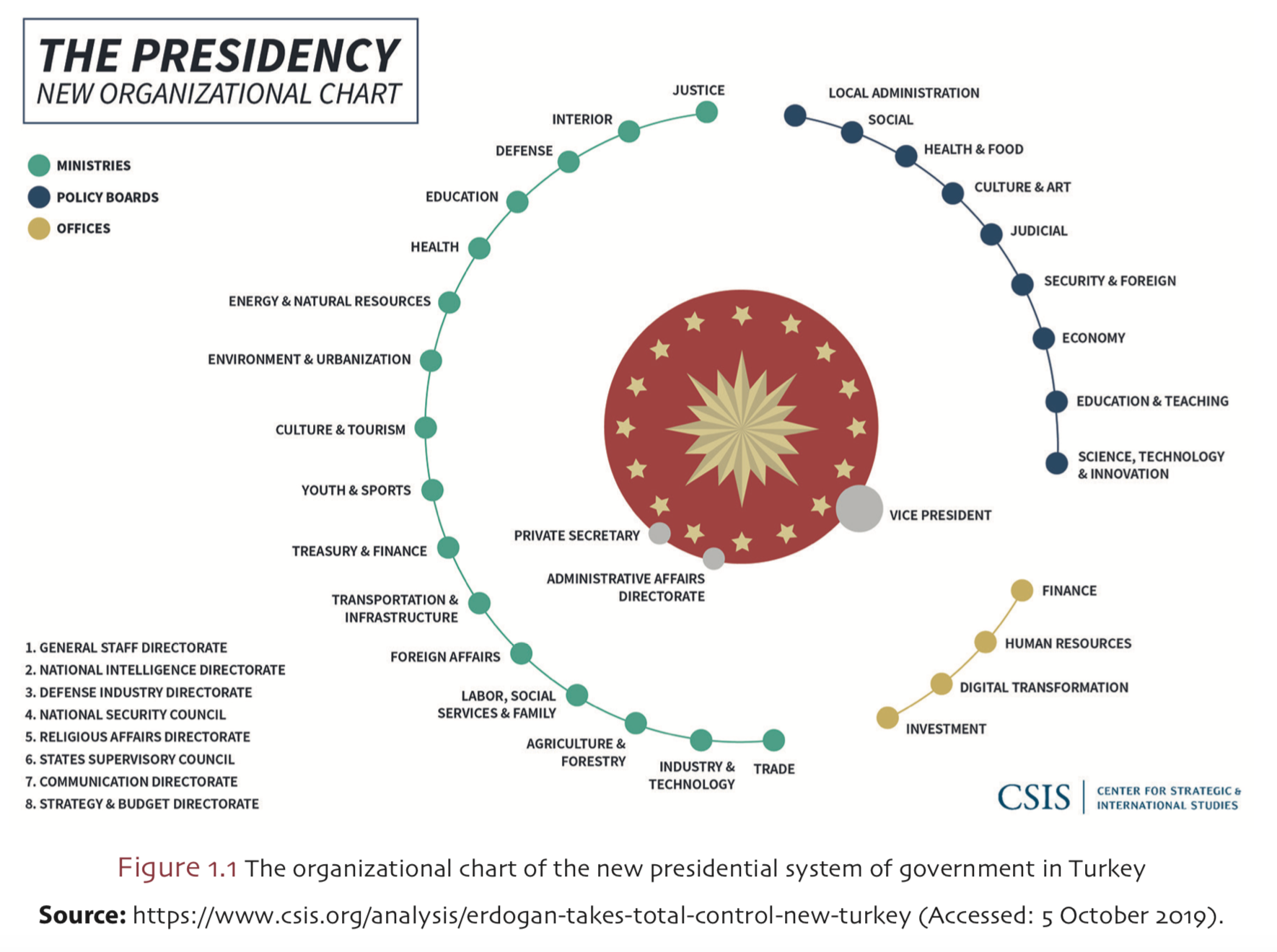
What are the officess in the new presidential system of government in Turkey?
- Finance
- Human Resources
- Digital Transformation
- Investment
When was the firs constitution adopted in Ottoman Empire?
The first constitution was adopted in 1876 in the Ottoman Empire, then amended in 1921 and 1924. Parliamentary elections were conducted after the 1876 constitution and continued until the establishment of modern Turkey (1923).
Which party was in power during the first military coop in After the establishment of modern day Turkey?
Turkey was governed by a single party (Republican Party) between 1923-1950, and in the 1950 elections, it was passed through a multi-party regime. The Democratic Party won the elections and remained in power until a military coup in 1960
When was the presidential system accepted in Turkey?
With the referendum held in 2017, the transition to the presidential system was accepted.
How many ministries does Turkey have under the new presidential system of government?
Turkey has sixteen ministries under the new presidential system of government.
What is the structure on Turkey's administrative system under the the new presidential system of government?
The new system in Turkey has four pillars; ministries (16), offices (4), policy boards (9) and directorates (8).
What is the impact of refugees and asylum seekers to the Turkish economy in the last decade?
Refugees and asylum seekers who are officially about 4 million, are contributing to Turkey as human resources and financial resources. Refugee human resources reduce costs by putting pressure on wages in the labor market, contribute positively to domestic demand and make a significant compensatory impact on the Turkish economy in the period of insufficient domestic demand.
What are the groups of classification for countries depending on there water resource?
According to the water assets countries are classified as follows: water-poor: the amount of water available per person per year: less than 1,000 m3. Water-scarce: the amount of water available per person per year, less than 2,000 m3. Water-rich: the amount of water available per person per year: more than 8000-10000 m3 (DSI, 2019).
DSI. (2019). Land and Water Resources. http://www. dsi.gov.tr/toprak-ve-su-kaynaklari. (Accessed: October 5, 2019).
How is Turkey classified according to water resource?
Turkey is not a country rich in water. According to the annual amount of water available per capita in Turkey is a country facing water scarcity. The amount of annual disposable water per capita is around 1,519 m3. According to the water assets countries are classified as follows: water-poor: the amount of water available per person per year: less than 1,000 m3. Water-scarce: the amount of water available per person per year, less than 2,000 m3. Water-rich: the amount of water available per person per year: more than 8000-10000 m3 (DSI, 2019).
DSI. (2019). Land and Water Resources. http://www. dsi.gov.tr/toprak-ve-su-kaynaklari. (Accessed: October 5, 2019).
Which mineral resources are poor in Turkey?
The following mineral resources are insufficient in Turkey: copper, manganese, graphite, paint soils, lead, aluminum, coal, zircon, zinc, arsenic, talc, titanium, iron, sulfur, mica, nickel, phosphate and clay minerals (Corlu Chamber of Commerce and Industry, Mining Industry in the World and Turkey (Corlutso, 2019).
Corlutso. (2019). Mining Industry in the World and Turkey, Çorlu Chamber of Commerce and Industry, https://www.corlutso.org.tr/uploads/ docs/dunyada_ve_turkiyede_madencilik_ sektoru.pdf. (Accessed: October 5, 2019).
Is Turkish manufacturing industry dependent on imports or exports?
90% of Turkish imports consist of intermediate and capital goods. Therefore, it can be said that the Turkish manufacturing industry has a high dependency on imports
What is PPP?
Purchasing power parities, abbreviated as PPPs, are indicators of price level differences across countries. PPPs tell us how many currency units a given quantity of goods and services costs in different countries.
What is the advantage of convert expenditure expressed in national currencies into an artificial common currency, the purchasing power standard (PPS)?
PPPs tell us how many currency units a given quantity of goods and services costs in different countries. Using PPPs to convert expenditure expressed in national currencies into an artificial common currency, the purchasing power standard (PPS), eliminates the effect of price level differences across countries created by fluctuations in currency exchange rates.
When was the first census conducted after the proclamation of the Republic in Turkey.
Turkey made its first official census in 1927, after the proclamation of the Republic.
Population was 13.7 million in the 1927 census.
When was the Central Bank established?
Following the Great Depression in 1929, Law No. 1567 on the Protection of the Value of the Turkish Currency put into force in 1930 and the Central Bank was established the same year.
What are the dimensions of International Property Rights?
International Property Rights has three main dimensions: legal and political environment, physical property rights, and intellectual property rights. Turkey ranks 66 among 125 countries (IPRI, 2019).
IPRI. (2019). International Property Rights Index. https://www.internationalpropertyrightsindex. org/countries. (Accessed: 1 October 2019).
How volatile is the growth rate in Turkey?
The volatility level of growth is quite unstable in the Turkish economy. The coefficient of variation for the growth is 89.6 in the period 2000-2019. It shows that the economic growth fluctuates by around 90% based on the period average. It can be said that this ratio is quite high and indicates an unstable growth trend.
What is the general condition of the labor market in Turkish economy in terms of occupational competence and skill inventory?
The Turkish labor market is at a disadvantage in terms of occupational competence and skill inventory. Therefore, the unemployment rate is relatively high compared to peer countries due to a lack of qualified labor force, lack of entrepreneurial and innovative culture and capacity. The Turkish economy has not been able to successfully complete its structural transformation neither in terms of economic sectors nor in terms of labor inventory
What is the condition of the relationship between investment and savings in Turkey?
Turkey is a chronic deficit country. There are not sufficient domestic savings for investments made in Turkey. Therefore, borrowing the savings of other countries is necessary to sustain economic development. The average savings rate as a proportion of national income is 22.9% on an annual basis in the 2000-2018 period, while the investment rate is 26.9%.