Derivative and its Applications
What does the derivative of a function represent?
The derivative of a function represents the rate of change of a function at a particular point.
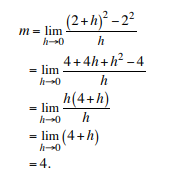
Find the slope of the tangent line to the curve y = x2 at the point (2, 4).
Denote the slope by m. Then
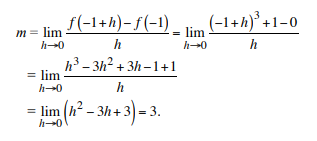
Find the slope of the tangent line to the curve y = x3 + 1 at the point (–1, 0).
Here f(x) = x3 + 1
f(–1) = (–1)3 + 1
= –1 +1
= 0
and
f(–1 + h) = (–1 + h)3 + 1.
The slope of the tangent at (–1, 0) is
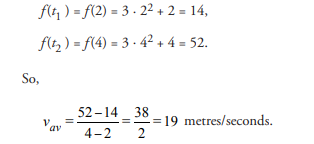
A particle moves along the x-axis in such a way that its position at time t is f(t) = 3t2+ t (metre). Find the average velocity vav over the interval [2, 4].
Here, t1=2 and t2=4. The values of f at these points are
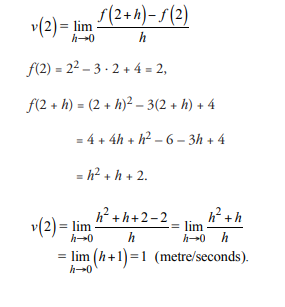
The motion of a particle is given by the function f(t) = t2 – 3t + 4. Find its velocity at the instant t = 2.
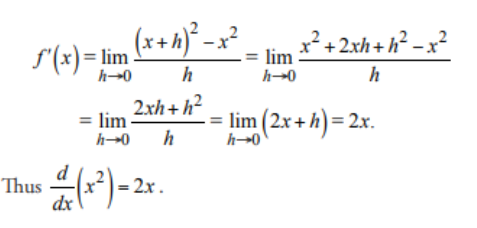
Given f(x) = x2, find the derivative f '(x).
We just need to apply the definition of derivative to the function f(x) = x2. On doing so, we get
For a constant function f(x) = c, what is the value of the derivative?
For a constant function f(x) = c the derivative is zero, that is, (c)' = 0. Indeed,

For the identity function f(x) = x, what is the derivative?
For the identity function f(x) = x, the derivative is 1, that is, (x)' = 1. Indeed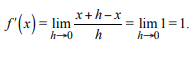
What is the derivative of a linear function f(x) = ax + b?
It can easily be shown that derivative of a linear function f(x) = ax + b is a, that is (ax+ b)' = a. For example,
(3x + 5)' = 3, (–2x – 2)' = –2.
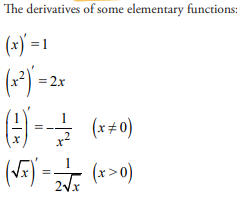
What are the derivatives of some elementary functions?
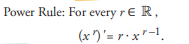
What is the power rule?
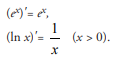
What are the derivatives of the exponential and natural logarithm functions?
What is the product rule?
Let f(x) and g(x) be differentiable at x, then f(x) + g(x), f(x) – g(x), f(x) . g(x) and f(x) /g(x) (Here g(x) ≠ 0 must be satisfied) are also differentiable and
(f(x) + g(x))' = f' (x) + g'(x)
(f(x) – g(x))' = f ' (x) – g'(x)
(f(x) . g(x))' = f' (x) . g(x) + f(x) . g'(x)
(The Product Rule)
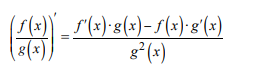
What is the quotient rule?
What is the constant rule?
From the product rule, it follows that if c ∈R is any constant, then
(c . f(x))' = c . f '(x) (The Constant Rule).
What is the chain rule?
The Chain Rule: The derivative of composite function f (g(x)) is f'(g(x)) . g' (x).
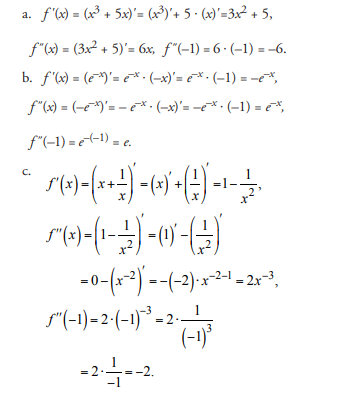
Find the second derivatives of the following functions at the point x = –1.

What is the equation of the tangent line to the curve y = f(x) at (x0, f(x0))?
The equation of the tangent line to the curve y = f(x) at (x0, f(x0)) is
y–f(x0)=f'(x0)(x–x0)
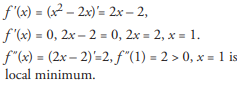
Find the local extreme point of f(x) = x2 – 2x.
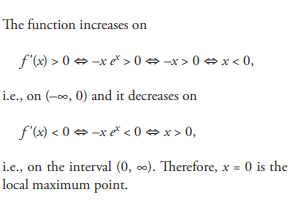
What are the local extremum points and intervals of decrease and increase of the function f(x) = (1 – x) ex?
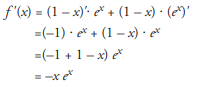
The derivative of f is found by applying the chain rule as